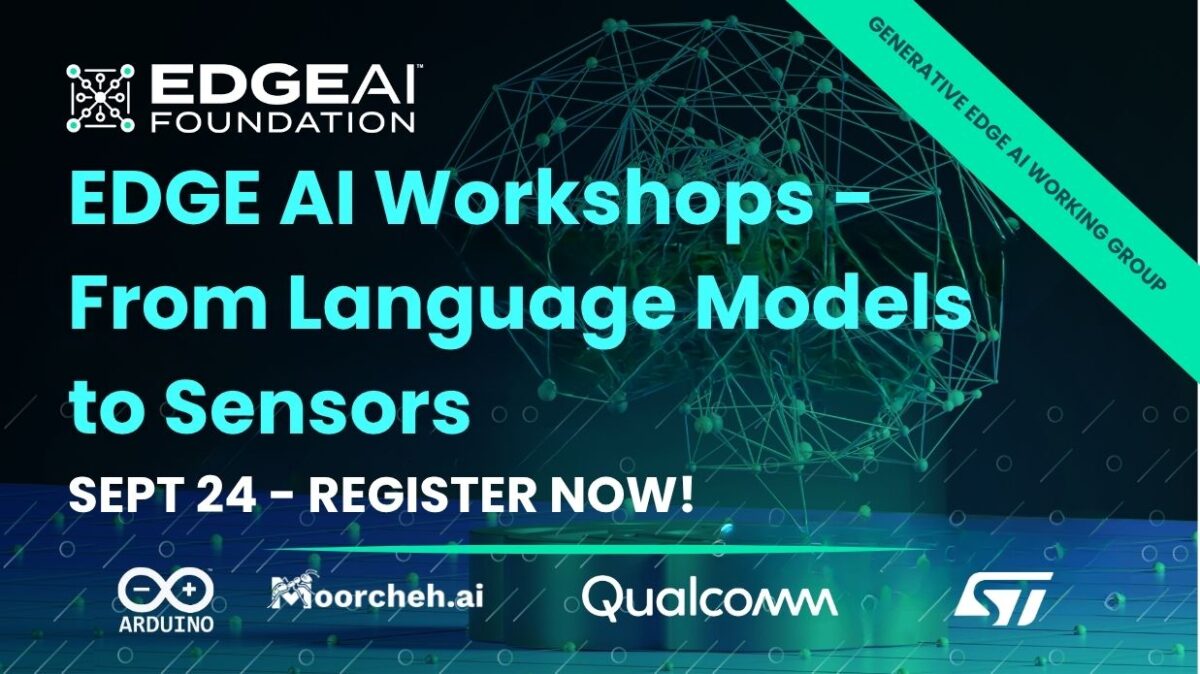
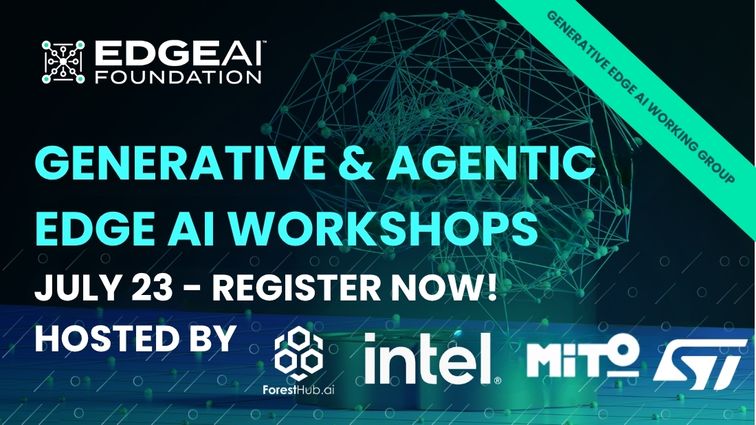
GENERATIVE AND AGENTIC EDGE AI WORKSHOPS

REGISTER HERE – https://streamyard.com/bjmiqevr68 

Join us for three back-to-back hands on workshops with Intel, STMicroelectronics, MiTO and ForestHub to learn the latest techniques and technologies in generative and agentic edge AI.

Please register but note that these workshops are FIRST COME FIRST SERVED based on availability of virtualized platforms.
——————————————–

WORKSHOP #1- Building your local voice assistant on compact edge device- Hosted by Danilo Pietro Pau, IEEE and ST Fellow & Ashutosh Kumar, Ph.D., M.B.A, AI Technical Marketing Lead at Intel

This workshop explores how to build a fully local, low-latency conversational AI agent optimized for edge devices. Participants will examine a production-ready pipeline integrating streaming Speech-to-Text, a quantized Small Language Model, and real-time Text-to-Speech, orchestrated via OpenVINO across CPU, GPU, and NPU on Intel® Core™ Ultra Processor powered edge device. We highlight advanced optimizations including neural VAD for fast endpointing, overlapping audio windows for accurate transcription, and token-level output streaming with punctuation-aware chunking to reduce time-to-first-audio. Through hands-on insights, developers will learn how to design responsive, power-efficient voice assistants that run entirely on-device—delivering privacy, reliability, and real-time interaction without cloud dependency.

What you will learn:
– Understanding how to quantize AI models with OpenVINO for optimized performance – be it speech to text, text to speech, or language models
– Explore how local machine learning models can be used to run multi-modal AI workloads for man
– Hands-on lab with open-source models and an application to try the workflow out in Jupyter notebook environment

* First 20 participants will get access to an instance to try it out and experience the compute efficiency of Intel® Core™ Ultra processor powered edge devices. Other participants are welcome to download the workshop and try on their own systems.
——————————

WORKSHOP #2: The Self-Driving Home: TinyAgents Cooperating over Tiny A2A on STM32 = Hosted by Marcus Rueb of ForestHub.ai

TARGET AUDIENCE
Embedded & firmware engineers, edge-AI developers, and technical decision-makers building local, sensor-driven products – anyone interested in running multiple cooperating agents on constrained MCUs/MPUs without the cloud.

GOALS
By the end of the session attendees will understand:
– How several TinyAgents run locally on the STM32N6 (Neural-ART NPU) and STM32MP2, each owning a domain – comfort, energy, safety.
– How those agents coordinate over Tiny A2A, a lightweight agent-to-agent protocol for low-power, bandwidth-constrained devices – instead of static rules/scenes.
– How this plays out across three concrete use cases:
* Comfort – a vision agent detects dirt/spills and dispatches the vacuum robot to the spot.
* Energy – agents detect real presence/usage, steer heating & cooling dynamically, and orchestrate bidirectional EV charging (V2H/V2G).
* Safety – on-device vision detects falls/injury (elderly care) and alerts instantly – no camera frame ever leaves the home.
– How to operate these agents in production: deploy, monitor (AgentOps), update and govern them across a fleet of homes – a full lifecycle, 100% local.

PREPARATION REQUIRED
– Nothing mandatory to follow along.
– To replay the demo: an STM32N6 Discovery kit and/or STM32MP2 board plus our walkthrough repo (link shared ahead of time); a Linux host or WSL environment recommended for the local toolchain.

DURATION
1 hour (technical webinar + live demo)

——————————
WORKSHOP #3 – Grounded Video Understanding on the Edge with Small Language Models – Hosted by Andrea Basso, PhD, MITO Tech Ventures

Deploying vision-language AI on edge devices is no longer just a matter of shrinking models, it requires rethinking how they are structured, optimized, and grounded. In this hands-on workshop, we present a practical approach to building efficient multimodal pipelines using small language models, lightweight vision components, and embedded NPUs.

Participants will learn how to optimize llama.cpp, extend multimodal projection layers for flexible resolutions, quantize models, and deploy YOLO on STM32MP2 hardware. The workshop will present the Narrative Camera, a real-world example of a grounded, multi-stage pipeline that transforms raw video streams into structured, human-readable narratives while minimizing hallucinations.

By the end of the workshop, attendees will have the tools and insights to design by themself an STM32MP2 edge-native AI systems that move beyond raw perception to meaningful, interpretable understanding.

EDGE AI SOLUTIONS: AI ON THE ROOF!

How is edge AI transforming commercial HVAC systems?

Join us on the latest EDGE AI Solutions livestream, co-hosted by Avnet, as Engenuity shares how its groundbreaking platform is bringing real-time intelligence directly to rooftop HVAC units (RTUs).

Discover how edge AI enables predictive maintenance, improved energy efficiency, smarter building operations, and greater sustainability—all while moving beyond traditional building management systems.

Learn how intelligent rooftop HVAC is shaping the future of commercial buildings and creating new opportunities for facility owners, operators, and technology providers.

Featured Speaker: David Rozio, CEO, Engenuity

EDGE AI Career: Inside Edge AI Hiring – What Engineers Need To Know

Getting into Edge AI isn’t just about having the right technical skills anymore. As competition for engineering roles continues to grow and hiring processes evolve, understanding how to navigate the job market has become just as important as the technology itself.

In Volume 4 of the EDGE AI Career Livestream in collaboration with 5V Tech, we’ll go inside the hiring process to explore what recruiters and hiring managers are really looking for, why strong candidates still get overlooked, and how engineers can position themselves more effectively in a competitive market.

Our panel brings together perspectives from hiring, academia, and engineering to share practical advice, real world experiences, and an honest look into what it takes to move from application to offer.

Featuring:
🎙️ Rick Morales – Head of Global Talent Acquisition, Ambiq

🎙️ Dr. Tinoosh Mohsenin – Associate Professor, Johns Hopkins University

🎙️ Sakshi Rathi – Senior Machine Learning Engineer & Tech Lead, Apple

Moderated by
Luke Perrins – Senior Consultant, Edge AI at 5V Tech and Chair of the EDGE AI FOUNDATION Career Working Group

What We’ll Explore
» The Reality of Hiring in Edge AI – What hiring managers actually look for, why applications get filtered out, and common mistakes candidates make.
» AI for Resume & LinkedIn Optimisation – How engineers are using AI tools, LinkedIn, and personal branding to improve visibility and strengthen applications.
» What Separates Successful Candidates – Insights into what helps candidates progress through interviews and stand out in a crowded market.
» Future Skills & Career Growth – How hiring is evolving, emerging skills companies are prioritising, and how engineers can stay competitive.

Whether you’re a student, recent graduate, career changer or engineer looking for your next opportunity, this session is designed to give you a clearer understanding of what actually helps candidates stand out and get hired in today’s Edge AI landscape.

You’ll leave with practical strategies, insider perspectives, and a clearer understanding of how to approach your next career move in Edge AI with confidence!

EDGE AI Talks: THOR x NeuroBench Challenge 2026: Tutorial & Submission Guide

The THOR x NeuroBench Challenge 2026 focuses on advancing Brain-Computer Interfaces (BCIs) by utilizing the Motor Imagery (MI) paradigm.

Participants are tasked with designing event-driven neuromorphic models to classify EEG signals from the OpenBMI dataset into left- or right-hand movements. The goal is to move this technology out of the clinical lab and into wearable decoders for motorized wheelchairs and robotic prosthetics, offering life-changing potential for individuals with stroke, ALS, or spinal cord injuries.

The awards for this challenge are sponsored by the EDGE AI FOUNDATION. This livestream tutorial provides a comprehensive, step-by-step guide to navigating the competition’s submission process.

The session breaks down the specific formatting requirements for the mandatory preprocessed data and walks through a complete example submission. Attendees will receive practical instructions on how to correctly build, package, and submit their solutions using the NeuroBench Code Harness during the Phase-I submission window.

EDGE AI Talks: THOR: The Future of Brain-Inspired Edge AI

Join us for an in-depth look at THOR, a next-generation approach to brain-inspired computing and energy-efficient AI hardware for the edge.

This session will explore how neuromorphic and adaptive computing architectures are reshaping the future of intelligent systems, enabling real-time AI with significantly lower power consumption and greater scalability for edge applications.

EDGE AI Solutions – No Bad Apples: Drones Delivering Healthier Crops with Vision-Based Edge AI

How is computer vision transforming food production?

Find out in the launch episode of the EDGE AI Solutions Livestream, hosted by industry veterans Jennifer Skinner-Grey (Avnet) and Pete Bernard (EDGE AI FOUNDATION).

We are breaking down actual, real-world deployments—not just theory. For this epsiode, Dr. Ivan Karbovnyk and Alex Fesiak of Indeema joins us to share a case study on automated apple inspection.

Key Takeaways:
– Overcoming practical barriers in agricultural edge AI.
– Scalable frameworks for vision-based quality control.
– Live insights during our interactive audience Q&A.

⏳ Join the livestream to learn from the experts and participate in the live discussion.

EDGE AI Career – The Upstream Advantage: Why Everything Flows from Who You Hire

In this episode, Kris Watson and Pete Bernard reveal a foundational truth of business and leadership: everything is downstream from the people you assemble and the culture you build. With 18 years as a Founding Recruiter, Kris has helped scale dozens of companies in the Edge Intelligence space. In this conversation, he and Pete dive deep into why talent density is the ultimate competitive advantage. Tune in as they explore:     •    The Upstream Effect: Why hiring is the root of every success and failure in business, plus the most common (and costly) pitfalls founders make when hiring.     •    The shocking frequency and true cost of bad early hires, and the simple process fixes that prevent them. Whether you’re a founder, manager, or building a world-class culture, this episode will fundamentally shift how you think about talent, team-building, and the real value of your people. The shocking frequency and cost of bad early hires from bad process, and the simple fixes.  Whether you’re a founder, a manager, or trying to build a world-class culture, this conversation will anchor how you look at talent, team-building, and the value of your people.

EDGE AI Talks: Flexible NPU for Edge AI: NXP i.MX95 in Action

NPUs are rapidly becoming a core component of modern heterogeneous SoCs, alongside CPUs and GPUs—unlocking significant performance gains for edge AI. However, as hardware evolves, software integration remains a key challenge, with developers often lacking unified frameworks to efficiently leverage all available compute resources.

In this upcoming EDGE AI Talk, we explore a flexible deployment SDK built on open-source ecosystems that enables fast and efficient integration of NPUs, supporting a wide range of AI model types. Through a real-world case study using NXP’s i.MX 95 SoC, we demonstrate how NPU support for LLM workloads was achieved in under four months.

The session will also feature an end-user perspective, showcasing how this approach enables seamless access to heterogeneous acceleration in production edge AI systems.

Edge AI Market Tracker and Forecast 2020–2030 PREVIEW!

This talk, titled “Edge AI Market Tracker and Forecast 2020–2030 PREVIEW features Knud Lasse Lueth, CEO of IoT Analytics, a leading provider of market insights for edge computing.

The session serves as a high-level preview of the company’s comprehensive research into the rapidly evolving edge AI landscape. Below is a description based on the event details:

Overview
As the demand for real-time decision-making and data privacy increases, processing power is shifting from the cloud to the “edge.” This talk explores the massive growth trajectory of the Edge AI market, which is projected to see a significant compound annual growth rate (CAGR) through 2030.

Key Discussion Points
Market Growth & Forecasts: A first look at the updated 2020–2030 market figures, including the hardware, software, and services driving the industry.

The Rise of IoT Intelligence: How the global installed base of edge devices—forecasted to exceed 40 billion by 2030—is becoming the “brains” of connected environments.

Key Technology Trends:

The adoption of tinyML on ultra-low-power microcontrollers.

The integration of AI capabilities directly into MCUs (Microcontroller Units).

The impact of 5G and RISC-V architecture on edge deployments.

Industry Applications: Real-world use cases across manufacturing (industrial AI), automotive (autonomous systems), and smart surveillance.

Strategic Insights: Where is the geographic center of the market shifting and what this means for global OEMs and vendors.

UNO Q EchoGlow Workshop – Part 1

Join Qualcomm, Arduino, Edge Impulse, and Supplyframe DesignLab for a hands-on workshop exploring the new Arduino UNO Q and on-device AI.

Dive deep into building, optimizing, and deploying AI models on real hardware, as participants learn how to create their very own smart lighting system that changes colors and responds to their voices. Participants will collect sample data and build a model with Edge Impulse, assemble a custom-built LED board and enclosure to house an UNO Q, and deploy their edge AI model to the finished device.

This workshop took place at EDGE AI San Diego 2026.